

Special Educational Needs
Special educational provision is educational or training provision that is additional to, or different from, that made generally for other children or young people of the same age by mainstream schools.
Orchard Park High School is ambitious for all its students and we believe that there is no ceiling on what can be achieved by anyone, regardless of their circumstances or background. We are committed to providing a supportive and inclusive learning environment, giving every young person the opportunity to fulfil their potential now, and in the future.
The leaders at Orchard Park are leaders for all students, enabling our teachers to be teachers of all students. Orchard Park is committed to distributed leadership to secure the best possible provision and outcomes for students with special educational needs. We have the same ambition for all our students, and recognise the importance and impact of prioritising our responsibilities to students with special educational needs.
We work in partnership with students and their families in identifying and providing for special educational needs. Where appropriate, we also work in partnership with other agencies. We recognise the importance of communication being inclusive, accessible and culturally sensitive to achieve effective partnership working.
Graduated response
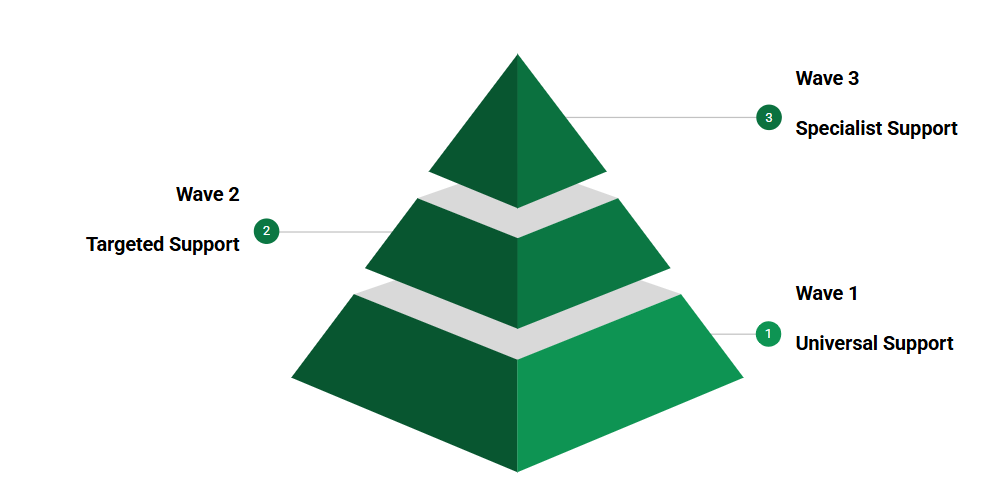
What does it mean to have a Special Educational Need?
A students has SEN if they have a learning difficulty or disability that requires special educational provision to be made for them.
They have a learning difficulty or disability if they have:
-
A significantly greater difficulty in learning than most others of the same age; or
-
A disability that prevents or hinders them from making use of facilities of a kind generally provided for others of the same age in mainstream schools.
What this means at Orchard Park
Students with SEND are supported from the very beginning of the school day. After roll calls students may go to the STAR (our mental health provision) or take part in one of our many interventions. Students receive support for a variety of reasons. Interventions include supporting their reading, handwriting, organisational skills or being physically active for our ADHD students.
All students are taught alongside their peers in mainstream as we believe the best place for a child with SEND is in front of a subject specialist. Every child on the SEND register has a bespoke pupil passport that is created alongside the child and parent so that we really get to know your child and support them in their learning.
If your child does not want to take part in one of our many free clubs, from scrabble to salsa dancing at lunchtime they have the opportunity to find a safe space in the library and play games or complete some homework with a teaching assistant to support them. We run further interventions later on in the day, including Zones of Regulation, ELSA and social skills. Students are monitored and supported through their intervention with our Assess, Plan, Do, Review model. Every day after school, our library is also open to support students' access and complete their homework with teaching assistant support.
Our SEND team
|
Mrs K Brown Assistant Headteacher – SENCO |
As SENCO, I am passionate about ensuring equity for our SEND learners amongst their peers whilst ensuring we have high standards for our students. |
|---|---|
|
Ms S Palmieri Deputy SENCO |
SEND education matters. As Deputy SENCO, I get to see progress which isn't only measurable by grades but by confidence, communication, and students finding and sharing their voices. Every win, small or large, feels significant and makes me a better educator: more patient, more creative, and more driven. |
|
Ms E Powlesland HLTA |
As HLTA, part of my role is researching and developing interventions for our SEND learners, to provide them with the tools they need to thrive. Seeing the students engage and progress in these interventions not only fills me with pride but confirms that equity in education is vital. |
|
Ms S Creffield SEND administrator |
Providing the SEND department with administration support means that our SEND educators can focus on what they do best, giving our SEND learners the best chance of success. It’s very rewarding to support such a dynamic team. |
Identification and assessment of children with SEND
At Orchard Park we work closely through our transition process with our local primary schools and families to ensure a smooth transition. This is supported by our whole school and a bespoke SEND transition day.
We will assess each student's current skills and levels of attainment on entry, which will build on previous settings and key stages, where appropriate. Class teachers will make regular assessments of progress for all students and identify those whose progress:
-
Is significantly slower than that of their peers starting from the same baseline.
-
Fails to match or better the child’s previous rate of progress.
-
Fails to close the attainment gap between the child and their peers.
-
Widens the attainment gap.
This may include progress in areas other than attainment, for example, personal, social and emotional development.
Slow progress and low attainment will not automatically mean a pupil is recorded as having SEN. Other barriers to learning will also be considered.
A referral system is also in place for teachers to raise concerns with the SENCO if they feel that a pupil may require support which is different from or additional to that which is delivered as part of the core offer. As part of the graduated approach, any referral includes strategies that the teacher has already implemented and their impact.
Parents/carers can also raise concerns either with the class teacher/tutor or by contacting Miss S Palmieri.
When deciding whether special educational provision is required, we will start with the desired outcomes, including the expected progress and attainment, and the views and wishes of the pupil and their parents. We will use this to determine the support that is needed and whether we can provide it by adapting our core offer, or whether something additional is needed.
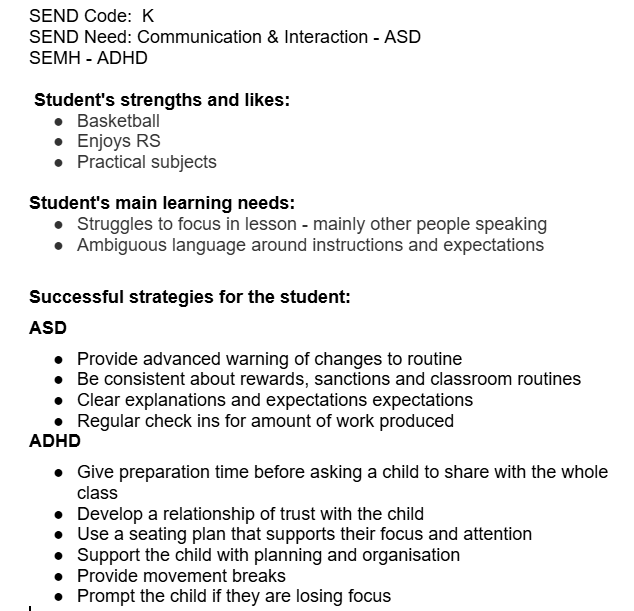
Pupil Passport
A pupil passport is a regularly reviewed document that contains the needs, strengths and individual strategies for every student with an EHCP or on SEN Support. These are developed in partnership with pupils and their parents/carers. Where appropriate, they might also include strategies recommended by other professionals.
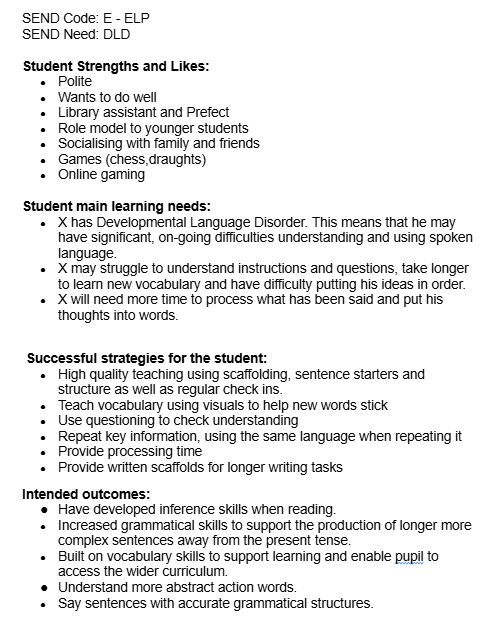
Pupil Passport Plus
Some students who require more specialised support will have individualised learning plans to complement pupil passports. For example, an individualised learning plan will be used to:
-
Track progress against long-term outcomes in Educational, Health and Care Plans (EHCNAs) for students working below age-related expectations.
-
Inform medium-term and daily curriculum planning and provision where children are accessing adapted curriculum pathways.
-
Inform intervention planning.
Universal provision – high quality teaching
Orchard Park High School ensures that a universal provision of high quality teaching is able to address gaps in foundational knowledge and skills. Through evidence-informed classroom routines and a well-planned curriculum, teachers are able to address reading fluency and accuracy, communication and language skills, writing composition and number facts. Our carefully selected and sequenced curricula ensure foundational subject-specific knowledge is secure at every step. For some students, effective in-classroom targeted support ensures gaps are identified and tackled quickly through our responsive and adaptive classroom practice.
Targeted support
We understand that some students may need additional support, this would usually come in the form of intervention. We run interventions twice daily covering a number of different areas to help close attainment gaps as well as support organisation, emotional regulation and handwriting.
|
A is for Autism |
External specialist provision for students with a diagnosis or who are awaiting an ASD diagnosis. It focuses on improving and supporting social confidence and social skills to ensure success in secondary school and life outside of education. |
|---|---|
|
Active Start |
Supporting students with ADHD by implementing a programme of alerting, organising and calming activities to regulate energy levels. |
|
ADHD |
Self-management and regulation tools for students with ADHD. |
|
Dramatherapy |
One-to-one drama therapy sessions for those who can struggle with talking therapy to help process previous issues, understand their needs further and build confidence. |
|
Dyslexia |
Students who have screened highly for dyslexia have an intervention to support them with their comprehension and phonological awareness. This should help build confidence and understanding in longer written pieces of work. |
|
EAL |
Students are removed from their fourth option block and supported with small group work to improve their English. |
|
ELSA |
Emotional Literacy is a one-to-one intervention where students are supported in understanding their own feelings, how to recognise them and react in appropriate ways in social situations. |
|
Handwriting |
Run for a half term at a time and then assessed this practice is done to help improve OT skills and improve handwriting for the students. |
|
Lego therapy club |
LEGO therapy club is a collaborative, play-based intervention where children with social communication difficulties work together in structured, assigned roles to build models, promoting communication, turn-taking, and problem-solving skills. |
|
Peer reading |
Students with below average reading ages when tested upon entry are paired with a year 9 student who they read to once a week. |
|
Reading fluency |
Reading fluency intervention aims to improve students' oral reading rate and expression by practising reading text fluently. |
|
RWI |
Read, Write, Inc is a phonics intervention that supports our most vulnerable students with accessing and improving their vocabulary, reading comprehension and oracy. |
|
SALT |
Speech and Language therapy happens once a week for our ELP students by a therapist who comes into school. They address misconceptions and support them in furthering their understanding. |
|
Social skills |
Our ELP students also have a social skills group where they practice talking to each other, problem-solving and turn taking. |
|
Stepping Stones |
At tutor time, students are supported further with their organisation, a tick list of their equipment, problem-solving and then tutor reading. |
|
TYC |
TYC is a structured (Direct Instructional) reading programme that helps students learn to read and comprehend. It uses a scripted approach to teach phonics and comprehension. |
|
Touchtyping |
Students who need laptops for KS4 are supported with touch typing lessons to ensure speed and accuracy for their GCSEs. |
|
Vocab |
Students in the ELP receive additional vocabulary lessons in replacement of their language lessons. Students discuss and break down key vocabulary from the week and are supported by their TA. |
|
Zones of regulation |
This is a group intervention that supports students in recognising when they are in the different 'zones'. For example, being angry or sad and techniques for how to move back to the 'green' zone as this is best for learning. |
Specialist Support
Some of our students may need further support beyond our high quality teaching and intervention. Our ELP students have a TA supporting them in lessons as well as removal from languages so they have additional social skills and SaLT support. Some of our EHCP mainstream students receive support from a teaching assistant in some of their lessons.
Staff training
Staff receive regular CPD training from the SENCO, Teaching and Learning Assistant Headteacher as well as other senior members of staff. Staff are supported when joining the school to ensure they implement the strategies we know work in the classroom to support all our learners. Staff are given ‘spotlights’ of specific SEND student each week to ensure they know the students needs fully and use these alongside each SEND child’s Pupil Passport.
Useful links
Teacher Handbook: SEND
With contributions from specialists across the sector, the handbook is a comprehensive resource for teachers and parents to use over time. It brings together practical examples of high-quality teaching – placing focus on removing barriers to learning, getting to know and understand individual learners, and bringing to life the graduated approach. o access this free resource, click on the link below and sign up to Whole School SEND:
Whole School SEND Online CPD Units
Free, flexible online learning to help develop inclusive practice.
Our SEN Information Report can be found on the school documents and policies page here.
To view the London Borough of Croydon's Local Offer, please click on the link below.